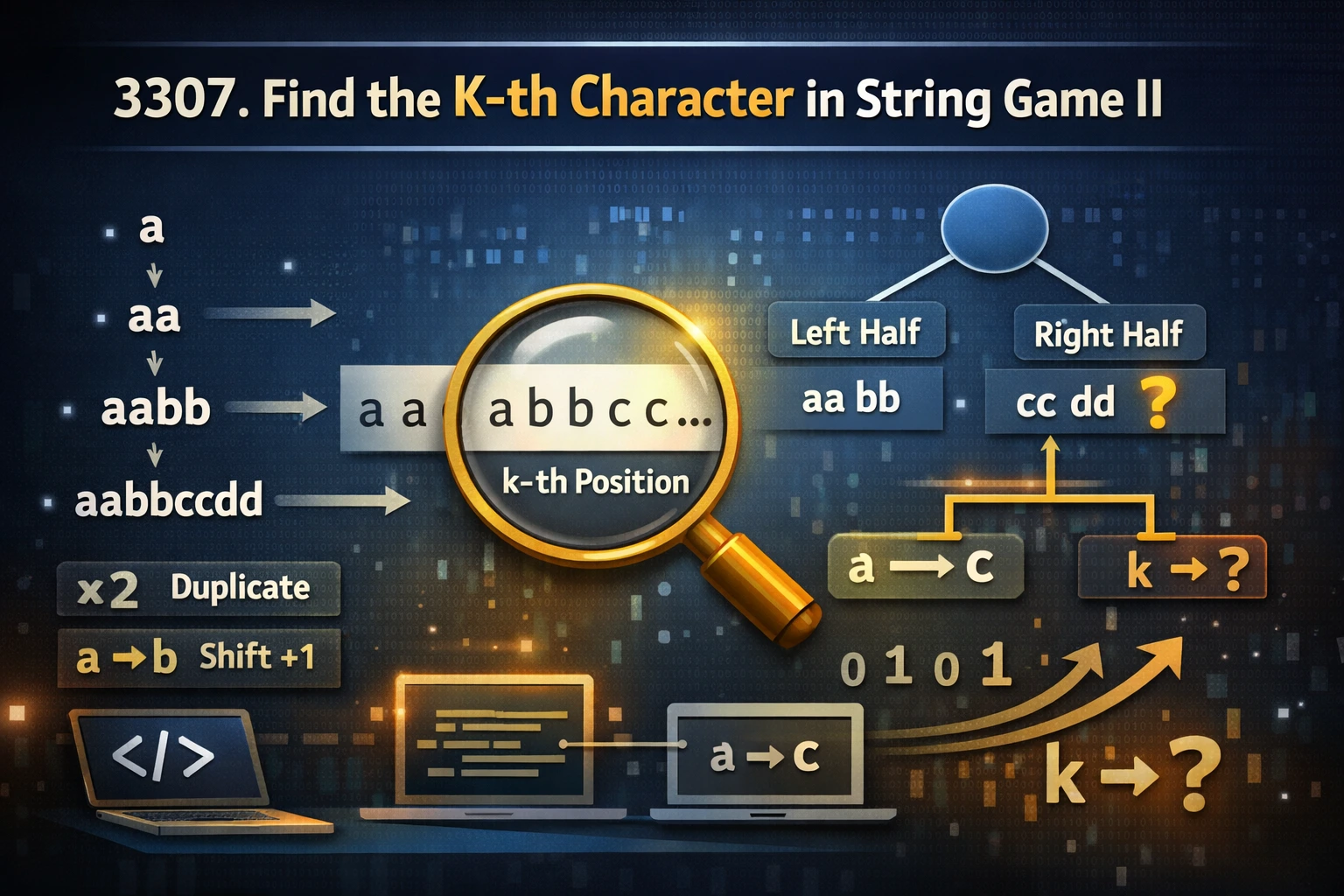
Modern algorithmic problems often test two things: logical insight and efficient implementation. One such challenge is 3307. find the k-th character in string game ii, a string‑processing problem from LeetCode that forces you to work smart instead of brute‑forcing massive string formations.
In this guide, we’ll walk through every detail of this problem — what it asks for, how string evolution works, why naive solutions fail, how to solve it efficiently, and how to implement working code in popular programming languages. You’ll walk away understanding not just what to do, but why it works.
Introduction
The problem 3307. find the k-th character in string game ii involves generating a string through a sequence of operations and then retrieving a specific character — the k‑th character — from the final string. Sounds simple, right? But here’s the catch: the string can expand to lengths far larger than can be handled in memory.
This problem is labeled as Hard on LeetCode, and for good reason. A naive solution that tries to literally build and store the entire string will run out of time and memory for large inputs. Instead, we must use clever mathematical and algorithmic insights to answer the question efficiently.
Understanding the Problem
In 3307. find the k-th character in string game ii, you start with a string:

You’re given:
- A positive integer k — the position of the character you need to find (1‑indexed),
- An array operations where each element is either
0or1.
Each value in operations tells you how to build the next version of the string:
-
If the operation is
0:
- Append the current string to itself.
- Example:
"a"→"a" + "a"→"aa".
-
If the operation is
1:
- Create a copy of each character in the string by shifting it to the next letter in the English alphabet.
- Example:
"c"→"cd"becausenext('c')='d'. 'z'wraps around to'a'.
Let’s visualize this with an example.
Example Walkthrough
Example 1
Input:

Process:
- Start:
"a" - First 0 →
"aa" - Second 0 →
"aaaa" - Third 0 →
"aaaaaaaa"
All operations append a copy of the string, so the final string is:

The 5th character is 'a'.
Example 2
Input:

Process:
- Start:
"a" - 0 →
"aa" - 1 →
"aabb"(append shifted version"bb") - 0 →
"aabbaabb" - 1 → the appended part is shifted — so second half becomes
"bbccbbcc"
Final string becomes a long sequence:

The 10th character is 'b'.
Why Brute Force Fails
A naive idea would be to simulate every operation and actually build the final string. But that’s impossible for large inputs because:
- Each operation doubles the string size.
- After n operations, the string has length 2ⁿ.
- Given up to 100 operations and
k <= 10¹⁴, the string could exceed 10³⁰ characters.
Clearly, building the string will never complete in time, nor can memory hold such huge data. So we need a mathematical shortcut.
The Key Insight: Work Backwards
The most efficient approach is to work backwards from the desired position in the final string rather than building it forward.
At each step, the final string consists of two parts:
- The left half — the string before the operation,
- The right half — a copy (either identical or shifted).
If we know the length of the string at each stage, we can decide whether our target k lies in the left half or right half. If it’s in the right half, we adjust k so it maps into the corresponding position in the left half, and track the cumulative character shifts applied.
This leads to a very efficient solution in O(log k) time.
Algorithm Breakdown
Here’s how the backward algorithm works step by step:
1. Find Final Length ≥ k
Start at length len = 1 (only "a").
Double until len >= k.
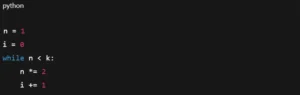
This tells us how many operations were applied to reach at least length k.
2. Track Shifts Backwards
We initialize a shift counter d = 0.
Then:
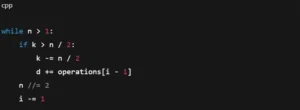
Explanation:
- If
klies in the second half, it comes from the first half (after shift). - We reduce
kto its equivalent position in the first half. - If the split was created by a type
1operation, characters in the second half were shifted by 1 — so add that tod.
3. Final Character
Once n = 1, we know the original string character was 'a'.
Each shift adds 1 to the character in alphabetical order. After all shifts:

We use modulo 26 because the alphabet loops (‘z’ → ‘a’).
Time and Space Complexity
- Time:
O(log k)— We only halve the string until its length reaches 1. - Space:
O(1)— We use a few constant variables.
This is dramatically better than attempting to build the string.
Code Solutions
Below are practical solutions in three languages.
Python Solution
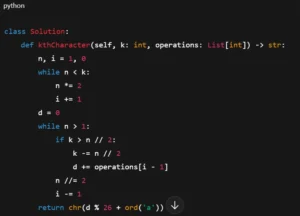
Clean logic
Efficient
Handles large k naturally
C++ Solution
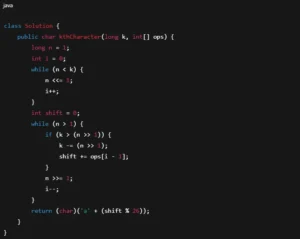
Java optimized bit shifts
Clear logic flow
Common Mistakes to Avoid
Off‑by‑One Operation Index
Remember: when backtracking, use operations[i‑1] not operations[i]. Otherwise, you might incorrectly reference beyond the actual sequence.
Ignoring Alphabet Wraparound
Make sure to apply modulo 26 — otherwise, adding shifts beyond 'z' will produce incorrect characters.
Why This Problem Is Valuable
This problem teaches a core algorithm lesson:
👉 You don’t always need to build the whole data to extract what you need. You can often trace back from the position or state you care about with mathematical reasoning.
This skill is vital in string algorithms, segment tree problems, compressed data parsing, AND interview scenarios.
Frequently Asked Questions (FAQs)
Q1. What does operations[i] == 0 mean?
It means append an exact copy of the current string to itself (like duplication).
Q2. Why work backward rather than forward?
Because the final string grows exponentially — you cannot build it for large k. Working backward traces the origin of a specific character.
Q3. Is this the only way to solve this problem?
No — you could use memoization or bit tricks, but all efficient paths use backtracking logic to avoid full construction.
Conclusion
The problem 3307. find the k-th character in string game ii looks simple on the surface but hides rich algorithmic depth. It challenges you to think beyond brute force and embrace smart tracing of string evolution.
The trick?
Use string growth patterns
Track the position backward
Count shifts only when necessary
Avoid building massive strings
If you apply these principles, you not only solve this problem but also improve your algorithmic thinking for many future challenges.